
Jedem, der die Prüfungsunterlagen und Software zu Nutanix NCP-US-6.5 (Nutanix Certified Professional - Unified Storage (NCP-US) v6.5) von Zertpruefung nutzt und die Nutanix Zertifizierungsprüfungen nicht beim ersten Mal erfolgreich besteht, versprechen wir, die Kosten für das Prüfungsmaterial 100% zu erstatten.
| Thema | Einzelheiten |
|---|---|
| Thema 1 |
|
| Thema 2 |
|
| Thema 3 |
|
| Thema 4 |
|
| Thema 5 |
|
>> NCP-US-6.5 Zertifizierungsfragen <<
Wenn Sie die Ziertifizierungsprüfung für Nutanix NCP-US-6.5 einmalig bestehen oder Ihre IT-Fähigkeiten erhöhen wollen, ist Zertpruefung Ihre beste Wahl. Nach langjährigen Bemühungen beträgt die Bestehensrate derNutanix NCP-US-6.5 Prüfung bereits 100%. Unsere Schulungsunterlagen zur Nutanix NCP-US-6.5 Prüfung enthalten vollständige und grenzlose Dumps, mit den Sie ganz einfach die NCP-US-6.5 Prüfung bestehen können.
38. Frage
An administrator needs to scale out an existing Files instance. Based on the Company's requirements, File instance has four FSVMs configured and needs to expand to six.
How many additional Client IP addresses and Storage IP addresses does the administrator require to complete this task?
Antwort: B
Begründung:
To scale out an existing Files instance, the administrator needs to add one Client IP and one Storage IP for each additional FSVM. Since the Files instance needs to expand from four FSVMs to six FSVMs, the administrator needs to add two Client IPs and two Storage IPs in total. The Client IPs are used for communication between the FSVMs and the clients, while the Storage IPs are used for communication between the FSVMs and the CVMs. References: Nutanix Files Administration Guide, page 28; Nutanix Files Solution Guide, page 7
39. Frage
An administrator is leveraging Smart DR to protect a Files share. There is a requirement that in the event of a failure, client redirection should be seamless. How should the administrator satisfy this requirement?
Antwort: C
Begründung:
Smart DR in Nutanix Files, part of Nutanix Unified Storage (NUS), automates disaster recovery (DR) by replicating shares between primary and recovery file servers (e.g., using NearSync, as in Question 24). The administrator is using Smart DR to protect a Files share and needs seamless client redirection in the event of a failure, meaning clients should automatically connect to the recovery site without manual intervention.
Understanding the Requirement:
* Smart DR Protection: Smart DR replicates the Files share from the primary site to the recovery site, typically with the primary site in read-write (RW) mode and the recovery site in read-only (RO) mode (as seen in the exhibit for Question 24).
* Seamless Client Redirection: In a failure scenario (e.g., primary site down), clients should automatically redirect to the recovery site without needing to reconfigure their connections (e.g., changing the share path or IP address).
* Files Share Context: Clients typically access Files shares via SMB or NFS, using a hostname or IP address (e.g., ileservershare for SMB or fileserver:/share for NFS).
Analysis of Options:
* Option A (Create a reverse replication policy): Incorrect. A reverse replication policy would replicate data from the recovery site back to the primary site, typically used after failover to prepare for failback. This does not address seamless client redirection during a failure-it focuses on data replication direction, not client connectivity.
* Option B (Enable redirection in the protection policy): Incorrect. Smart DR protection policies define replication settings (e.g., RPO, schedule), but there is no "redirection" setting in the policy itself.
Client redirection in Nutanix Files DR scenarios is managed through external mechanisms like DNS, not within the protection policy.
* Option C (Update the AD and DNS entries): Correct. Seamless client redirection in Nutanix Files DR scenarios requires that clients can automatically connect to the recovery site without changing their share paths. This is achieved by updating Active Directory (AD) and DNS entries:
* DNS Update: The hostname of the file server (e.g., fileserver.company.com) should resolve to the IP address of the primary site's File Server under normal conditions. During a failure, DNS is updated to point to the recovery site's File Server IP address (e.g., the Client network IP of the recovery FSVMs). This ensures clients automatically connect to the recovery site without changing the share path (e.g., ileserver.company.comshare continues to work).
* AD Update: For SMB shares, the Service Principal Name (SPN) in AD must be updated to reflect the recovery site's File Server, ensuring Kerberos authentication works seamlessly after failover.This approach ensures clients are redirected without manual intervention, meeting the
"seamless" requirement.
* Option D (Activate protected shares on the recovery site): Incorrect. Activating protected shares on the recovery site (e.g., making them RW during failover) is a necessary step for failover, but it does not ensure seamless client redirection. Without updating DNS/AD, clients will not know to connect to the recovery site-they will continue trying to access the primary site's IP address, requiring manual reconfiguration (e.g., changing the share path), which is not seamless.
Why Option C?
Seamless client redirection in a Nutanix Files DR scenario requires that clients can connect to the recovery site without changing their share paths. Updating AD and DNS entries ensures that the file server's hostname resolves to the recovery site's IP address after failover, and AD authentication (e.g., Kerberos for SMB) continues to work. This allows clients to automatically redirect to the recovery site without manual intervention, fulfilling the requirement for seamlessness.
Exact Extract from Nutanix Documentation:
From the Nutanix Files Administration Guide (available on the Nutanix Portal):
"To ensure seamless client redirection during a Smart DR failover, update Active Directory (AD) and DNS entries. Configure DNS to resolve the file server's hostname to the recovery site's File Server IP address after failover, and update the Service Principal Name (SPN) in AD to ensure Kerberos authentication works for SMB clients. This allows clients to automatically connect to the recovery site without manual reconfiguration."
:
Nutanix Files Administration Guide, Version 4.0, Section: "Smart DR Failover and Client Redirection" (Nutanix Portal).
Nutanix Certified Professional - Unified Storage (NCP-US) Study Guide, Section: "Nutanix Files Disaster Recovery".
40. Frage
A team of developers are working on a new processing application and requires a solution where they can upload the ... code for testing API calls. Older iterations should be retained as newer code is developer and tested.
Antwort: C
Begründung:
Nutanix Objects supports versioning, which is a feature that allows multiple versions of an object to be preserved in the same bucket. Versioning can be useful for developers who need to upload their code for testing API calls and retain older iterations as newer code is developed and tested. Versioning can also provide protection against accidental deletion or overwrite of objects. References: Nutanix Objects Administration Guide The development team needs a solution to upload code via API calls while retaining older versions of the code as newer versions are developed. This use case aligns with versioned object storage, which supports API- based uploads (e.g., S3 APIs) and automatic versioning.
Analysis of Options:
* Option A (Create a bucket in Objects with Versioning enabled): Correct. Nutanix Objects, part of Nutanix Unified Storage (NUS), provides S3-compatible object storage. It supports versioning, which allows multiple versions of an object to be retained when new versions are uploaded. The S3 API is ideal for programmatic uploads via API calls, meeting the developers' requirement to upload code for testing while retaining older iterations.
* Option B (Create an SMB Share with Files and enable Previous Versions): Incorrect. Nutanix Files supports SMB shares with the Previous Versions feature (via Self-Service Restore), which allows users to access earlier versions of files. However, SMB is not typically accessed via API calls-it's designed for file sharing over a network (e.g., Windows clients). This does not align with the requirement for API-based uploads.
* Option C (Provision a Volume Group and connect via iSCSI with MPIO): Incorrect. Nutanix Volumes provides block storage via iSCSI, which is suitable for applications requiring low-level storage access (e.g., databases). However, iSCSI does not support API-based uploads or versioning, making it unsuitable for the developers' needs.
* Option D (Create an NFS Share mounted on a Linux Server with Files): Incorrect. An NFS share in Nutanix Files allows file access over the NFS protocol, which can be mounted on a Linux server. While NFS supports file storage, it does not natively provide versioning, and NFS is not typically accessed via API calls for programmatic uploads.
Why Option A is the Best Solution:
* Nutanix Objects with Versioning: Objects supports S3 APIs, which are widely used for programmatic uploads in development workflows. Enabling versioning ensures that older versions of the code are retained automatically when new versions are uploaded, meeting the requirement to retain older iterations.
* API Support: The S3 API is a standard for API-based uploads, making it ideal for the developers' workflow.
* Scalability: Objects is designed for scalable object storage, suitable for development and testing environments.
Exact Extract from Nutanix Documentation:
From the Nutanix Objects Administration Guide (available on the Nutanix Portal):
"Nutanix Objects supports versioning for buckets, allowing multiple versions of an object to be retained.
When versioning is enabled, uploading a new version of an object preserves the previous versions, which can be accessed or restored via S3 API calls. This feature is ideal for development workflows where older iterations of files need to be retained."
:
Nutanix Objects Administration Guide, Version 4.0, Section: "Bucket Versioning" (Nutanix Portal).
Nutanix Certified Professional - Unified Storage (NCP-US) Study Guide, Section: "Nutanix Objects Features".
41. Frage
An administrator created a bucket for an upcoming project where internal users as well as an outside consultant .... Object Browser. The administrator needs to provide both internal and consultant access to the same bucket.
The organization would like to prevent internal access to the consultant, based on their security policy.
Which two items are requires to fulfill this requirement (Choose two.)
Antwort: A,D
Begründung:
Nutanix Objects supports directory services integration, which allows administrators to configure access keys based on directory and email-based users. This enables granular access control and security for buckets and objects. The administrator can configure directory services under the Access Keys section in Prism Central, and then generate access keys for internal users from the directory service and for the consultant from an email address2. References: Nutanix Objects Administration Guide2
42. Frage
Exhibit: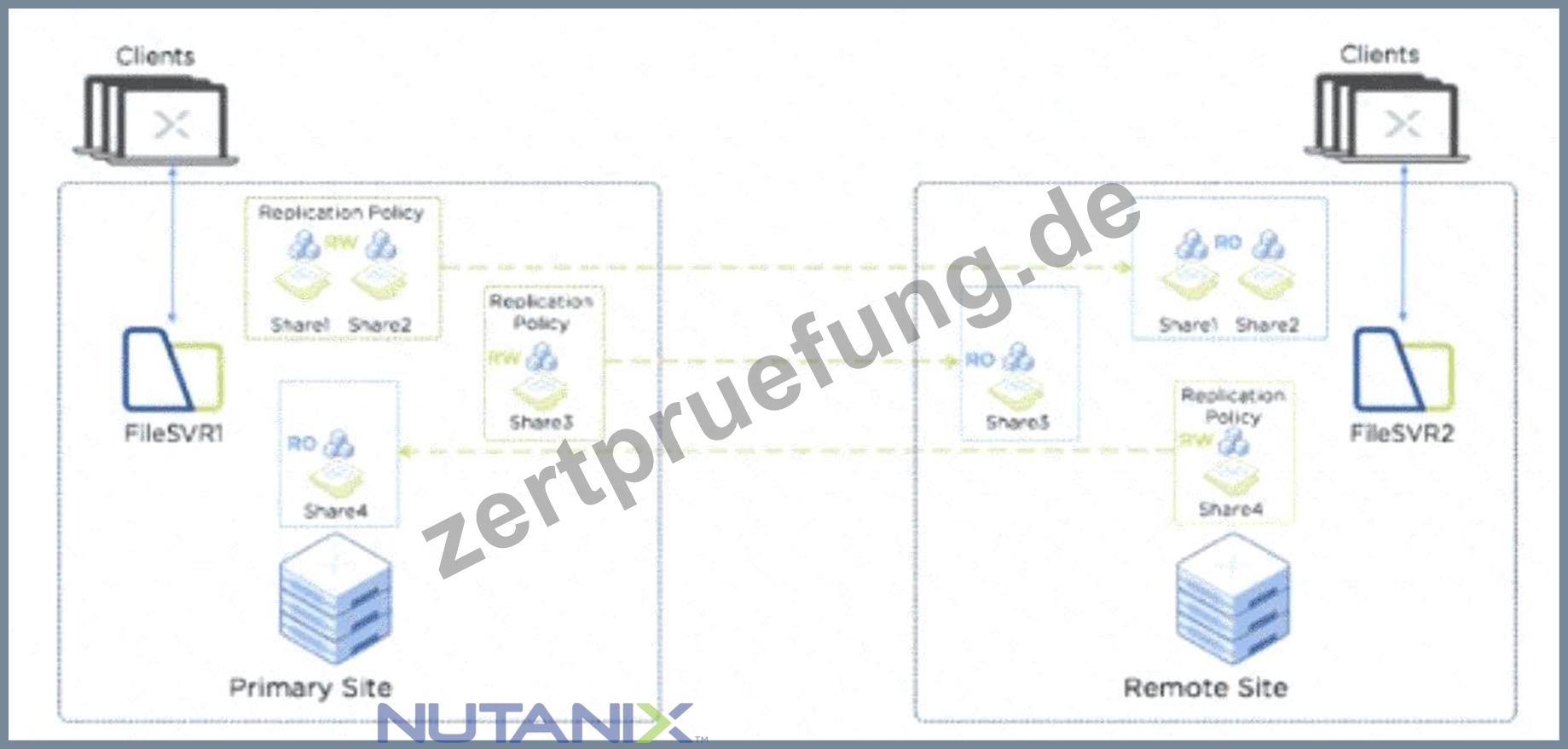
What best describes the data protection illustrated in the exhibit?
Antwort: C
Begründung:
The exhibit illustrates a data protection setup involving Nutanix Files, a component of Nutanix Unified Storage (NUS). It shows two sites: a Primary Site and a Remote Site, each with a File Server (FILE SVR1 and FILE SVR2, respectively). The Primary Site has shares (Share1, Share2, Share3, Share4) with a replication policy applied. Share1 and Share2 are marked as RW (read-write) on the Primary Site and RO (read-only) on the Remote Site, while Share3 has a replication policy with RW on both sites. Share4 is RO on the Primary Site and RW on the Remote Site. Clients access the shares on both sites, and the replication policy governs the data protection mechanism between the sites.
Analysis of the Exhibit:
* Two Sites (Primary and Remote): The setup involves replication between two sites, indicating a disaster recovery (DR) or high-availability scenario.
* Replication Policy: The replication policy is applied to the shares, with specific shares being RW on one site and RO on the other (e.g., Share1 and Share2 are RW on Primary, RO on Remote). This suggests asynchronous replication, as synchronous replication would typically allow RW access on both sites with zero data loss.
* Share3 (RW on Both Sites): This indicates a special configuration, possibly for load balancing or specific workload requirements, but the primary focus is on the replication policy for DR.
* Share4 (RO on Primary, RW on Remote): This suggests a failover scenario where the Remote Site can take over as the primary for certain shares.
Analysis of Options:
* Option A (Smart DR): Incorrect. Smart DR is a Nutanix feature that simplifies disaster recovery by automating snapshot-based replication and recovery plans. While Smart DR can use replication policies, the exhibit specifically shows a replication setup between File Servers with RW/RO configurations, which aligns more directly with a replication mechanism like NearSync. Smart DR is more about the orchestration of recovery, not the replication mechanism itself.
* Option B (Metro Availability): Incorrect. Metro Availability provides synchronous replication between two sites with zero Recovery Point Objective (RPO), meaning no data loss. It typically allows RW access on both sites (with one site being primary) and requires low latency between sites (e.g., <5 ms). The exhibit shows RW/RO configurations, indicating asynchronous replication, and does not suggest zero RPO, making Metro Availability an incorrect fit.
* Option C (Availability Zones): Incorrect. Availability Zones in Nutanix refer to distributing data across zones within a single cluster or cloud environment for high availability, not replication between two distinct sites. The exhibit clearly shows two separate sites with replication, not a single cluster with zones.
* Option D (NearSync): Correct. NearSync is a Nutanix data protection mechanism that provides near- synchronous replication with low RPOs (e.g., 1-15 minutes). It is commonly used for Nutanix Files to replicate shares between sites for disaster recovery. The exhibit's RW/RO configuration aligns with NearSync, where the Primary Site is RW, and the Remote Site is RO for replicated shares, allowing failover to the Remote Site if needed. The replication policy shown in the exhibit matches NearSync's behavior of replicating data asynchronously with a configurable RPO.
Why Option D?
NearSync is designed for disaster recovery scenarios where data is replicated between two sites with a low RPO, ensuring minimal data loss. The exhibit's depiction of replication between FILE SVR1 and FILE SVR2, with RW/RO configurations for shares, is a hallmark of NearSync for Nutanix Files. The presence of a replication policy further supports this, as NearSync uses such policies to define replication schedules and RPOs. Metro Availability (option B) would require synchronous replication with zero RPO, which is not indicated by the RW/RO setup, and the other options (Smart DR, Availability Zones) do not fit the replication scenario shown.
Exact Extract from Nutanix Documentation:
From the Nutanix Files Administration Guide (available on the Nutanix Portal):
"NearSync provides near-synchronous replication for Nutanix Files shares between two sites, enabling disaster recovery with low Recovery Point Objectives (RPOs) ranging from 1 to 15 minutes. Shares on the primary site are typically read-write (RW), while the remote site is read-only (RO) for replicated shares. A replication policy defines the replication schedule and RPO, allowing failover to the remote site in case of a disaster." Additional Notes:
* The exhibit's depiction of Share3 (RW on both sites) is a less common configuration but can be achieved with NearSync by allowing specific shares to be writable on both sites for load balancing or specific use cases. However, the overall setup (replication between sites with RW/RO for most shares) aligns with NearSync.
* Metro Availability would typically show zero RPO and RW access on both sites for the same shares, which is not the case here.
:
Nutanix Files Administration Guide, Version 4.0, Section: "Data Protection with NearSync" (Nutanix Portal).
Nutanix Data Protection Guide, Version 6.0, Section: "NearSync for Disaster Recovery" (Nutanix Portal).
Nutanix Certified Professional - Unified Storage (NCP-US) Study Guide, Section: "Nutanix Files Data Protection".
43. Frage
......
Die Schulungsunterlagen zur Nutanix NCP-US-6.5 Prüfung von Zertpruefung sind von den erfahrenen IT-Experten aus ihren Erfahrungen entworfen, sie sind eine Kombination von Fragen und Antworten, daher sind sie nicht vergleichbar. Da unsere professionelle Berufsgruppe und die genauesten Prüfungsunterlagen zur Nutanix NCP-US-6.5 Prüfung haben, sind die Bestehensrate von Zertpruefung die höchste unter allen Webseiten in der ganzen Welt. Wenn Sie Zertpruefung wählen, dann sind Sie auf dem Weg zum Erfolg.
NCP-US-6.5 Exam: https://www.zertpruefung.de/NCP-US-6.5_exam.html